TL;DR. A stiff neck that appears overnight, locked to one side and painful to turn, is what most people mean by torticollis. It is one of the most common musculoskeletal complaints there is, and it usually has a mechanical cause rather than a dangerous one. The stiff neck remedies people search for at 6 a.m. are mostly about getting through the day; the useful question is why it happened and whether it will keep coming back. You can book an assessment at our Côte-des-Neiges clinic to get that answer.
You did nothing. You went to bed fine and woke up unable to check your blind spot. Turning your head means turning your whole body, and the muscle on one side of your neck feels like a rope.
Here is what is going on, why it is so common, and what happens when you come in about it.
What a stiff neck or torticollis actually is
Torticollis comes from two Latin words: tortus, twisted, and collum, neck. In adults it is used loosely for a neck that has locked up, usually on one side, with the head held slightly turned or tilted because straightening it hurts.
Your neck is seven small vertebrae stacked on top of each other, with joints at the back of each level that let you turn and tilt, discs between them, and a set of muscles that both move the head and hold it up all day. The one you can feel as a rope down the side, from behind the ear to the collarbone, is the sternocleidomastoid. When the joints or the muscles on one side are irritated, the surrounding muscles tighten to protect them, and that guarding is what feels like a lock.
In most cases there is no single dramatic cause. The guideline physiotherapists follow describes chronic or insidious neck pain as recurrent and episodic: it comes, it settles, and it can come back.
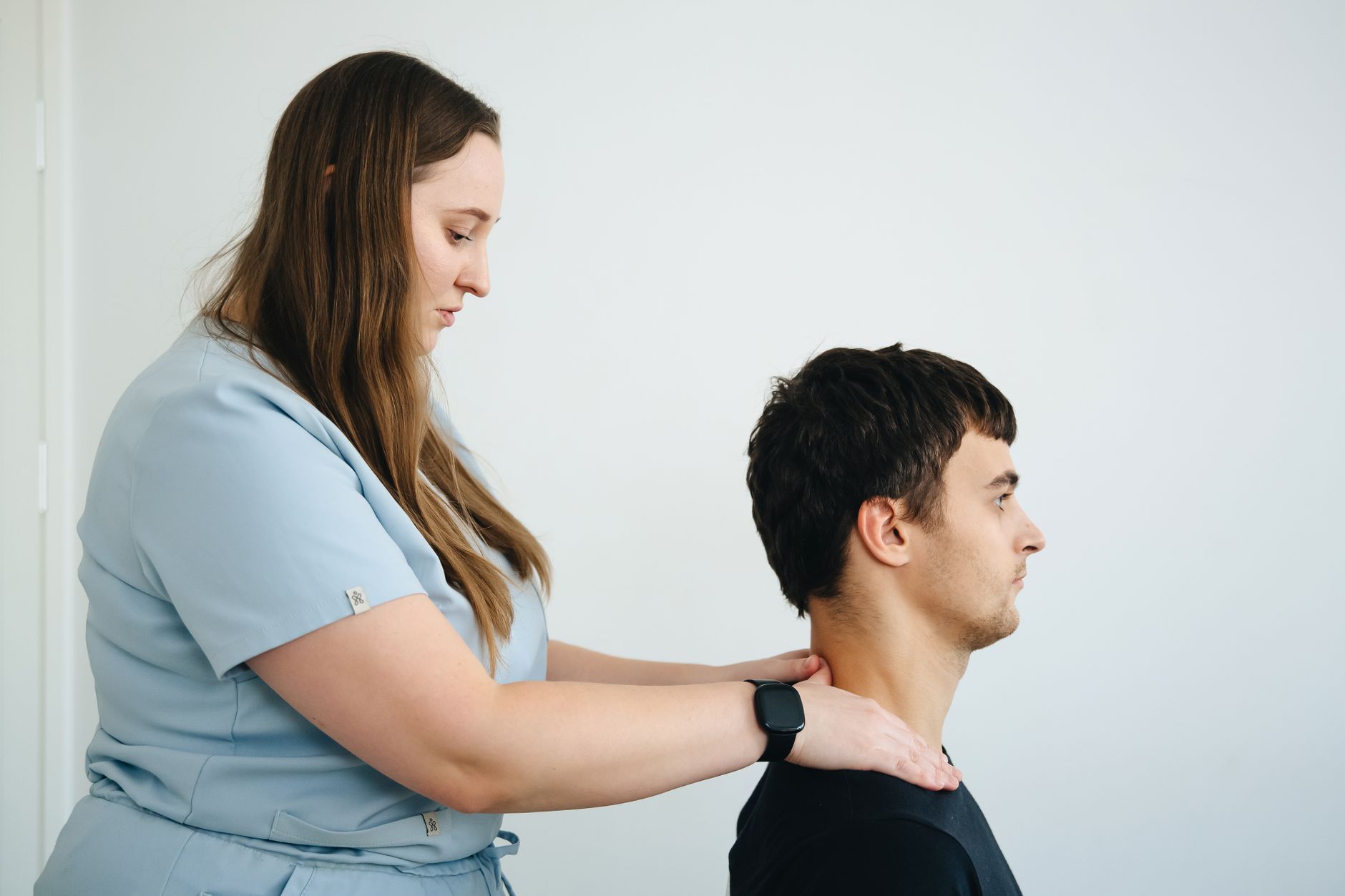
Why did my neck lock up overnight?
People want a reason, and the honest answer is that the research names risk factors rather than single causes. Two systematic reviews in the guideline found the strongest and most consistent predictors of a new episode of neck pain to be being female and having had neck pain before. Older age, high job demands, a history of smoking, low support at work and a history of low back pain may also play a part. A neck problem can also travel: tingling in the hand that started with a stiff neck is a pattern we see often enough to have written about the hand side of it.
What people notice in the days before an episode, and what an assessment asks about:
Stiff neck remedies: what people try, and what actually needs a look
A search for stiff neck remedies returns the same short list every time: heat, gentle movement, a better pillow, painkillers. We are not going to hand you a protocol from a web page, because what is right for a neck depends on what is wrong with it, and that is the job of an assessment. What we can do is tell you what separates a neck that will settle on its own from one that is worth bringing in.
| What you notice | A stiff neck that usually settles | Worth an assessment | See a doctor first |
|---|---|---|---|
| How it started | Woke up with it, or after a long stretch in one position | It keeps coming back, or this is the third time this year | After a fall, a collision or a blow to the head |
| Where it hurts | One side of the neck, into the top of the shoulder | Pain travelling down the arm, or into the shoulder blade | Pain with numbness or weakness in both arms or the legs |
| What else is going on | Nothing. You feel fine otherwise | Headaches, pins and needles, a hand that feels clumsy | Fever, unexplained weight loss, dizziness, trouble speaking or swallowing, a history of cancer |
| How you move | Stiff, but it loosens through the day | Stiff for days, and you have stopped doing things because of it | You cannot move it at all, or the pain is severe and constant |
The third column is the one to read twice. The guideline instructs clinicians to screen every neck for signs of serious pathology, including infection, cancer, cardiac or arterial involvement, ligament damage at the top of the neck, nerve dysfunction and fracture. Those are rare. They are also the reason a neck that comes with the wrong company is a doctor's visit, not a search.
What a neck assessment looks at
A first appointment for a stiff neck is mostly finding out which structures are irritated and which are just guarding. It is hands-on, but it is not rough.

What we do about it
Once the assessment has found the true cause of your pain, your physiotherapist builds an individualized plan of care around three phases of recovery.
For neck pain our team provides evidence-based care built around physiotherapy, massage therapy and kinesitherapy. Electrotherapy, manual therapy, joint mobilization and repeated movement are used to relieve pain, recover mobility and reduce stiffness. Deep tissue massage, trigger point therapy and myofascial release address muscle tension. Ergonomic changes, mobility coaching and strength work are there for the part that matters most on a recurring neck: making the next episode less likely.
We offer direct billing to several insurance companies. Check your plan for physiotherapy coverage before you book.

Frequently asked questions
Should I use heat or ice on a stiff neck?
Is a stiff neck ever serious?
Why does mine keep coming back?
Do I need a referral?
Sources
- Blanpied PR, Gross AR, Elliott JM, Devaney LL, Clewley D, Walton DM, Sparks C, Robertson EK. Neck Pain: Revision 2017. Clinical Practice Guidelines Linked to the International Classification of Functioning, Disability and Health From the Orthopaedic Section of the American Physical Therapy Association. Journal of Orthopaedic & Sports Physical Therapy 2017;47(7):A1-A83. https://doi.org/10.2519/jospt.2017.0302
- Cleveland Clinic. Torticollis. Medically reviewed, last updated 28 February 2022. https://my.clevelandclinic.org/health/diseases/22430-torticollis
- Physio Pain Solutions. Neck pain treatment page, as published on 21 September 2026.
If this is not your first stiff neck, the useful next step is finding out why. You can book an assessment online in under a minute.